
Just announced: New Viltrox AF 26mm f/2.8 EVO Z Lens
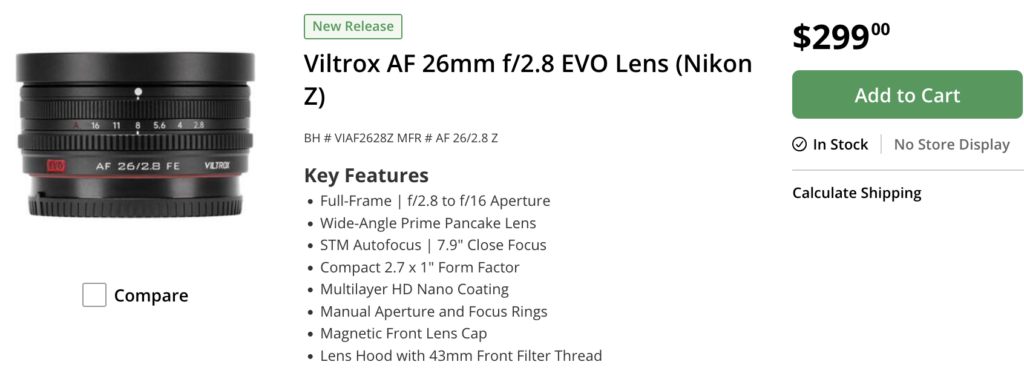
You can now preorder the new Viltrox 26mm f/2.8 Z AF pancake lens at BHphoto, Amazon USA, Viltroxstore, Amazon EU&AUS&CA, Fotoerhardt.

You can now preorder the new Viltrox 26mm f/2.8 Z AF pancake lens at BHphoto, Amazon USA, Viltroxstore, Amazon EU&AUS&CA, Fotoerhardt.
Chris tested the four High Res cameras from each company. That’s what he thinks about them:
So who wins?

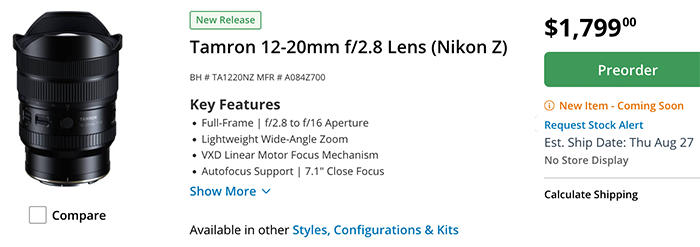
On July 15 Tamron will announce this new 12-20mm f/2.8 Full Frame autofocus lens! Price should be a bit above $1500.
Here is the full leaked press text:
TAMRON 12-20mm F2.8 for SONY E & NIKON Z (Model A084)
Pro Performance Minus the Weight. Ultra-Wide Built For the Field.
The defining feature of the 12-20mm F2.8 (Model A084) is its ultra-wide focal range, from 12mm to 20mm. The overwhelming breadth of the 12mm perspective enables dynamic expression that seems to “capture the entire expanse of a scene.” With a bright F2.8 aperture maintained throughout the entire zoom range, this lens is poised to become the “new protagonist” for astrophotography and interior shooting.
SonyAlphaRumors.com
The optical system incorporates an XGM (eXpanded Glass Molded Aspherical) lens element, three GM (Glass Molded Aspherical) lens elements, and multiple special lens elements. This design effectively suppresses peripheral blurring and color fringing while correcting sagittal coma flare — a common challenge in astrophotography — ensuring high sharpness from the center to the extreme edges of the frame.
SonyAlphaRumors.com
Despite its exceptional imaging performance, the lens achieves a sophisticated balance of size and weight, measuring just 4.7” (119.3mm) in length and weighing only 20.2oz. (570g).¹ While compact, it remains a professional-grade tool equipped with various switches and rings for superior operability.
For autofocus, the lens features the VXD (Voice-coil eXtreme-torque Drive), a high-speed, high-precision linear motor focus mechanism. Furthermore, with an MOD (Minimum Object Distance) of 7.1” (0.18m) at the 12mm wide end, the lens offers outstanding close-up performance for creative versatility.
¹ Length and weight are for Sony E-mount.
Features:
—Beyond the scope of vision — the overwhelming perspective only 12mm can capture
—Stunning corner-to-corner resolution for astrophotography and nightscapes
—Enhanced mobility for landscapes — a compact and lightweight design
—Comprehensive control features to meet professional demands
—High-speed, high-precision, and quiet performance with VXD linear motor focus mechanism
—Stunning close-up performance — unleashing the dynamism of ultra wide-angles
—Compatible with TAMRON Lens Utility™ — seamless support for video and stills
—Mastery of light — the artistry of a 12-blade circular diaphragm
—Evolution of form — introducing the “Tone Profile Next” lens design
—Integrated flower-shaped lens hood, integrated rear filter holder, and locking front lens cap
—Includes protective lens wrap
Model Name: A084
Focal Length: 12-20mm
Format size: Di III
Maximum Aperture: F2.8
Minimum Aperture: F16
Diagonal Angle of View: 121°58′ – 94°30′ (for full-frame mirrorless format)
Lens Construction: 17 elements, 12 groups
Filter Diameter: – Integrated rear filter holder
Minimum Focus Distance: 7.1” / 0.18m (WIDE), 11.1” / 0.28m (TELE)
Max. Mag. Ratio: 1:5.8 (WIDE) / 1:9.1 (TELE)
Maximum Diameter: Ø90mm
Length: 4.7” (119.3mm) Sony E / 4.8” (121.3mm) Nikon Z
Weight: 20.2oz (570g) Sony E-mount / 20.7oz (585g) for Nikon Z
Diaphragm Blades: 12 (circular diaphragm)
Standard Accessory: Front cap, Rear cap, Lens wrap, integrated hood
Compatible Mount: Sony E & Nikon Z

Meike has officially announced the development of the AF 85mm F1.2 lens—a full-frame, autofocus prime lens featuring a fast F1.2 aperture. It will utilize Meike’s latest proprietary technology, prioritizing weight reduction while maintaining high optical quality; the optical design is already largely complete, with the lens body weight kept under 900g. Two development paths are currently being explored:
Which version do you prefer?
–
via Weibo

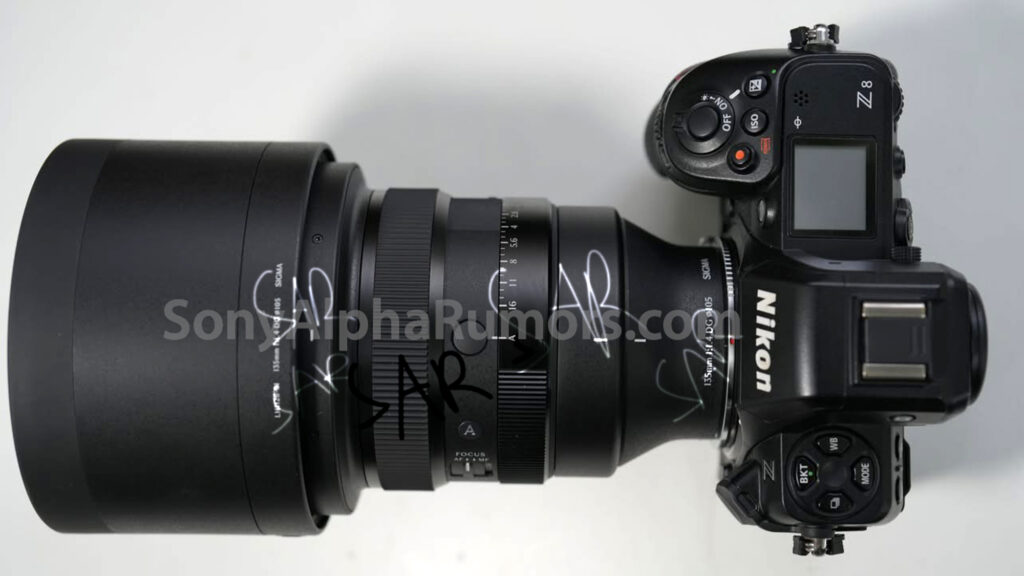
Viltrox is teasing the launch of a new EVO lens.
A trusted source (Thanks again!!!) already told us we will get the Viltrox 26mm f/2.8 EVO pancake lens for Sony E and Nikon Z. Release this month with a price tag of $299.
We already saw an image of the E-mount version of this lens:

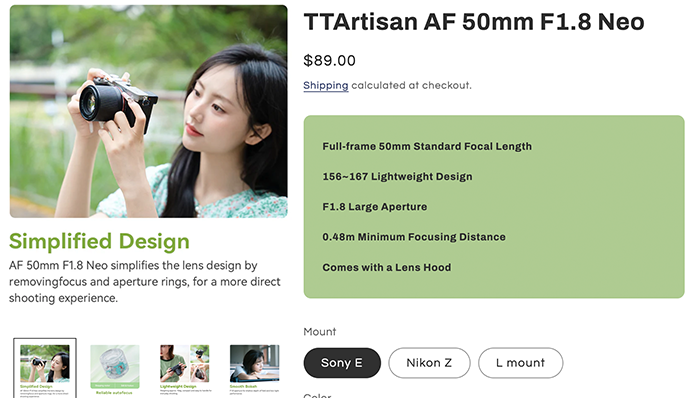
This is quite cool: You can get a fast 50mm autofocus lens for just $89 at BHphoto, Amazon, and the TTArtisan Store!