PetaPixel: Which High-Resolution Full-Frame Camera Has the Best Sensor?

Chris tested the four High Res cameras from each company. That’s what he thinks about them:

1. Panasonic Lumix S1R II (44 Megapixels)
  • At base ISO, this model resolved slightly less detail than the other cameras, though the difference is very minor.
  • At higher ISOs (above 5000), it applies aggressive baked-in noise reduction to the RAW files, resulting in cleaner images but a noticeable loss of fine detail.
  • It has the slowest readout speed of the group at around 37ms, which can result in more rolling shutter distortion when using the electronic shutter.
  • However, its in-camera high-resolution multi-shot mode is a notable feature that works effectively when shooting on a tripod.
2. Sony a7R VI (66 Megapixels)
  • Thanks to its higher resolution, it offers a noticeable improvement in overall detail, making it highly effective for heavy cropping or large-scale printing.
  • It showed strong dynamic range and high-ISO performance, which is attributed to image-stacking technology and the noise advantages of having more pixels at equivalent viewing distances.
  • Its readout speed has improved significantly over previous generations to around 19–20ms, though some rolling shutter can still be observed in fast-action scenarios.
3. Canon EOS R5 Mark II(45 Megapixels)
  • Its overall sharpness and detail are comparable with the Nikon Z8.
  • While it uses baked-in noise reduction in its RAW files, this sensor handles it well, preserving detail while keeping images clean at higher ISOs.
  • Equipped with a stacked sensor, it boasts a very fast readout speed of around 6 to 6.5ms, making rolling shutter virtually non-existent and making the electronic shutter highly practical for high-speed action.
4. Nikon Z8(45 Megapixels)
  • Like the Canon, it delivers strong sharpness and detail, but produces slightly cleaner shadow details and smoother blacks when shooting at high ISOs.
  • Featuring a fast readout speed of under 4ms, it allows users to shoot fast action and sports using the electronic-only shutter without worrying about rolling shutter distortion.
  • The sensor’s balance of speed, dynamic range, and clean image quality remains a solid asset for shooters.

So who wins?

  • For Raw Sensor Performance (Detail, Dynamic Range, and ISO): The Sony a7R VI is the clear top performer. It is favored for its high 66-megapixel resolution, which provides unmatched cropping flexibility, and its class-leading dynamic range (greatly aided by its dual-exposure image stacking).
  • For Speed, Wildlife, and Action: The Nikon Z8 takes the crown. Its sensor scanning speed of under 4ms is so fast that it completely eliminates the need for a mechanical shutter, allowing you to capture high-speed action with zero rolling shutter issues.
  • For the Best All-in-One Hybrid Package: The Canon EOS R5 Mark II is highly praised as the most versatile option. It beautifully splits the difference by combining excellent 45-megapixel detail, strong high-ISO noise control, and a fast 6ms stacked sensor that enables incredibly high burst rates with minimal rolling shutter.
In short, the Sony a7R VI stands out as the best for outright image quality, the Nikon Z8 is the best for speed-oriented action, and the Canon R5 Mark II is the best all-around camera that does everything in a single package.

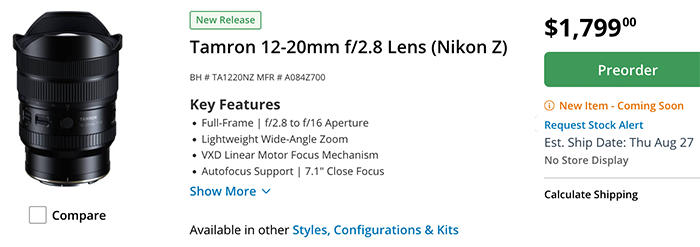
LEAKED: Tamron 12-20mm f/2.8 Z lens coming in July 15

On July 15 Tamron will announce this new 12-20mm f/2.8 Full Frame autofocus lens! Price should be a bit above $1500.

Here is the full leaked press text:

TAMRON 12-20mm F2.8 for SONY E & NIKON Z (Model A084)

Pro Performance Minus the Weight. Ultra-Wide Built For the Field.

The defining feature of the 12-20mm F2.8 (Model A084) is its ultra-wide focal range, from 12mm to 20mm. The overwhelming breadth of the 12mm perspective enables dynamic expression that seems to “capture the entire expanse of a scene.” With a bright F2.8 aperture maintained throughout the entire zoom range, this lens is poised to become the “new protagonist” for astrophotography and interior shooting.
SonyAlphaRumors.com 
The optical system incorporates an XGM (eXpanded Glass Molded Aspherical) lens element, three GM (Glass Molded Aspherical) lens elements, and multiple special lens elements. This design effectively suppresses peripheral blurring and color fringing while correcting sagittal coma flare — a common challenge in astrophotography — ensuring high sharpness from the center to the extreme edges of the frame.
SonyAlphaRumors.com
Despite its exceptional imaging performance, the lens achieves a sophisticated balance of size and weight, measuring just 4.7” (119.3mm) in length and weighing only 20.2oz. (570g).¹ While compact, it remains a professional-grade tool equipped with various switches and rings for superior operability.
For autofocus, the lens features the VXD (Voice-coil eXtreme-torque Drive), a high-speed, high-precision linear motor focus mechanism. Furthermore, with an MOD (Minimum Object Distance) of 7.1” (0.18m) at the 12mm wide end, the lens offers outstanding close-up performance for creative versatility.

¹ Length and weight are for Sony E-mount.

Features:
—Beyond the scope of vision — the overwhelming perspective only 12mm can capture
—Stunning corner-to-corner resolution for astrophotography and nightscapes
—Enhanced mobility for landscapes — a compact and lightweight design
—Comprehensive control features to meet professional demands
—High-speed, high-precision, and quiet performance with VXD linear motor focus mechanism
—Stunning close-up performance — unleashing the dynamism of ultra wide-angles
—Compatible with TAMRON Lens Utility™ — seamless support for video and stills
—Mastery of light — the artistry of a 12-blade circular diaphragm
—Evolution of form — introducing the “Tone Profile Next” lens design
—Integrated flower-shaped lens hood, integrated rear filter holder, and locking front lens cap
—Includes protective lens wrap

Model Name: A084
Focal Length: 12-20mm
Format size: Di III
Maximum Aperture: F2.8
Minimum Aperture: F16
Diagonal Angle of View: 121°58′ – 94°30′ (for full-frame mirrorless format)
Lens Construction: 17 elements, 12 groups
Filter Diameter: – Integrated rear filter holder
Minimum Focus Distance: 7.1” / 0.18m (WIDE), 11.1” / 0.28m (TELE)
Max. Mag. Ratio: 1:5.8 (WIDE) / 1:9.1 (TELE)
Maximum Diameter: Ø90mm
Length: 4.7” (119.3mm) Sony E / 4.8” (121.3mm) Nikon Z
Weight: 20.2oz (570g) Sony E-mount / 20.7oz (585g) for Nikon Z
Diaphragm Blades: 12 (circular diaphragm)
Standard Accessory: Front cap, Rear cap, Lens wrap, integrated hood
Compatible Mount: Sony E & Nikon Z

Meike announced the development of a new 85mm f/1.2 Z-mount lens

Meike has officially announced the development of the AF 85mm F1.2 lens—a full-frame, autofocus prime lens featuring a fast F1.2 aperture. It will utilize Meike’s latest proprietary technology, prioritizing weight reduction while maintaining high optical quality; the optical design is already largely complete, with the lens body weight kept under 900g. Two development paths are currently being explored:

  1. Engineering plastic version: 750g–780g
  2. Metal version: 870g–900g.

Which version do you prefer?

via Weibo

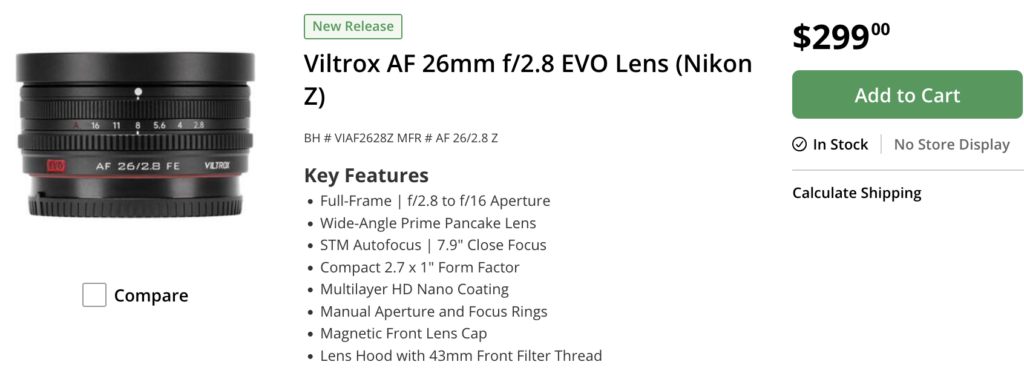
Viltrox 26mm f/2.8 pancake Z lens is coming soon for $299

Viltrox is teasing the launch of a new EVO lens.

A trusted source (Thanks again!!!) already told us we will get the Viltrox 26mm f/2.8 EVO pancake lens for Sony E and Nikon Z. Release this month with a price tag of $299.

We already saw an image of the E-mount version of this lens:

DZOFILM Announces Octopus II Multi-Mount Lens Adapter & Marlin 1.4x Extender

Press text:

DZOFILM has announced the launch of the Octopus II Adapter and Marlin 1.4x Extender, providing with greater flexibility, compatibility, and efficiency across a wide range of filmmaking applications, from short-form bloggers, content creators, livestreamers and YouTubers to independent filmmakers, commercial media and advertising, and professional DOPs.

Octopus II: 2nd Generation Multi-Mount Lens Adapter
The new Octopus II is a highly versatile multi-mount lens adapter that supports E, Z, L, and RF mount lenses, as well as Super35, full-frame, and medium-format sensors. With 7.12% more internal space, it offers improved compatibility with DZOFILM’s Arles, Arcana, Vespid, Catta, Pictor, Gnosis, and other professional cinema lenses.

The second-generation design is up to 49% lighter, weighing as little as 190g (depending on mount). Its strong aluminum body is paired with a stainless-steel mount that is rated for more than 100,000 mounting cycles with 0.01mm precision, ensuring long-term reliability and durability.

The redesigned ergonomic handle features directional guides that make lens changes easier, particularly when working with handheld or fully rigged camera setups. A detachable 1/4″ threaded base allows the center of gravity to be shifted onto the adapter, reducing stress on the camera’s native mount. In addition, the factory pre-set flange focal distance eliminates the need for calibration while ensuring accurate infinity focus.

Marlin 1.4x Extender with Integrated Back-Focus Adjustment
The new Marlin 1.4x Extender increases effective focal length by 1.4x while maintaining light loss below one stop, enabling lenses designed for Super35 to cover full-frame sensors.

The extender incorporates premium high-refractive-index SR optical elements, large-diameter aspherical lenses, and an internally flocked design that effectively minimizes stray light. Chromatic aberration is tightly controlled, helping preserve the original character of the lens. Integrated back-focus adjustment eliminates the need for operators to detach the lens or use shims during setup and fine-tuning.

Manufactured with stainless-steel mounts on both sides, the Marlin 1.4x Extender is engineered for long-term reliability and durability. Precision machining further helps prevent binding during mounting and operation.